
Barn Demolition in East Tennessee: A Landowner's Guide
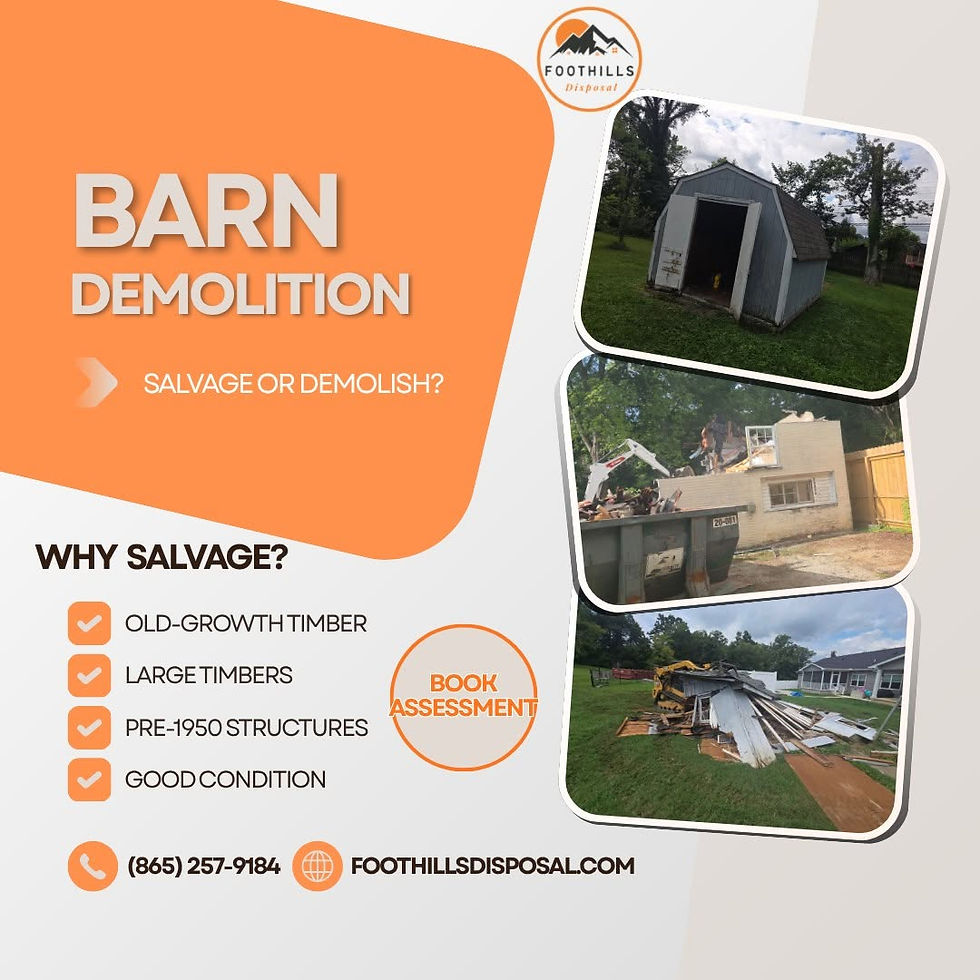
An aging barn is a familiar fixture on rural properties throughout Knox County and the surrounding counties, and for many landowners, deciding what to do with one that's past its useful life is a decision that gets postponed for years. Understanding what barn demolition actually involves — the regulatory side, the cost drivers, and the safety considerations — helps landowners finally move from indecision to a clear plan.
Assessing Whether Your Barn Genuinely Needs to Come Down
Not every aging barn is beyond saving, and it's worth getting an honest structural assessment before assuming demolition is the only path forward. Signs that typically point toward removal rather than repair include a significantly sagging or partially collapsed roofline, rot concentrated in primary support posts rather than just surface siding, and foundation-level deterioration spreading across multiple sides of the structure.
If the assessment does point toward removal, working with experienced barn demolition contractors near Knoxville who regularly handle agricultural structures — not just residential sheds — matters, since barns present a meaningfully different scope than a typical backyard outbuilding. Larger debris volume, often a poured concrete floor, and structural elements like hay lofts or wide clear-span roof trusses all require equipment-assisted disassembly rather than hand tools.
What Regulations Apply to Agricultural Structures
Depending on your specific property's zoning classification, barn demolition permit requirements can differ from standard residential structure removal. It's worth confirming directly with Knox County or your specific county's codes enforcement office whether your barn's size and your property's zoning trigger the same permitting process as a residential outbuilding, since assuming agricultural exemption without confirming it is a common and sometimes costly mistake.
A provider offering full-scale barn demolition services in Knoxville with genuine experience on rural and agricultural properties typically knows the specific permitting nuances for different zoning classifications across Knox County and neighboring counties, and can advise you accordingly before you're surprised by a requirement mid-project.
What's Commonly Found Inside Older Barns
Barns accumulate decades of stored material in a way that backyard sheds usually don't — old farm equipment, fencing supplies, feed and chemical containers, and sometimes fuel storage for equipment that hasn't run in years. Before demolition begins, this contents inventory needs proper assessment and sorting, since agricultural chemical containers in particular may require special handling separate from general structural debris.
This sorting phase is one of the most commonly underestimated parts of a barn removal project, and it's worth discussing directly with your contractor before work begins so it's factored into both the timeline and the cost estimate rather than discovered as a surprise once the teardown is already underway.
Understanding Barn Demolition Cost
Barn removal costs more than a standard shed removal for straightforward reasons — greater debris volume, heavier equipment requirements, and often a concrete floor that needs to be broken up and removed. Reviewing a detailed outbuilding cost breakdown for the Knoxville region gives you a sense of the lower end of the outbuilding spectrum, with barns scaling upward from there based on size, contents, and site accessibility.
If your barn removal project is part of a broader property clean-up that also involves general clutter or debris that's accumulated around the structure over the years, working with a team that also handles general junk removal in Knoxville alongside the structural teardown means one crew and one project timeline covers everything, rather than requiring you to coordinate separate vendors for the loose debris and the structure itself.
Preserving What's Worth Keeping Before Demolition
If part of your hesitation about barn removal is the material itself — old barn wood has genuine value and appeal for furniture-making, accent walls, and similar reclaimed-material projects — it's worth discussing salvage options with your contractor before demolition begins. Not every contractor accommodates this automatically, but many are willing to set aside specific boards or beams if you ask before the teardown starts rather than after.
Wildlife and Pest Activity Common in Unused Barns
Barns that have sat unused or lightly used for years frequently become established habitat for wildlife worth knowing about before demolition begins. Barn owls commonly roost in lofts and rafters, and depending on the season, may have active nests that raise both practical and, in some cases, protection considerations before disturbance. Bats often roost in roof peaks and wall cavities in significant numbers, and certain species carry specific timing protections around maternity roosting season in late spring and summer.

Groundhogs, skunks, and other burrowing animals frequently establish dens along barn foundations, while raccoons and opossums commonly take up residence in accessible upper areas. A contractor experienced with rural and agricultural demolition knows to assess for active wildlife presence before work begins, both for basic safety and, where applicable, to avoid conflicting with wildlife protection timing restrictions that can affect when certain demolition work is permitted to proceed.
Historical Considerations for Older Barns
Some barns across East Tennessee genuinely qualify as historically or architecturally significant, particularly log or timber-frame structures dating back a century or more. If your barn falls into this category, it's worth pausing before committing to full demolition, since options beyond straightforward teardown sometimes exist. Local historical societies and, in some cases, state preservation offices maintain interest in documenting or occasionally relocating structures with genuine historical value.
Even when preservation isn't practical for your specific situation, having the structure documented — photographed, measured, its construction techniques noted — before it comes down can be a meaningful way to preserve some record of it, particularly for barns that have been part of a family's land for multiple generations.
What's Commonly Found Inside Older Barns
Barns accumulate decades of stored material in a way that backyard sheds usually don't — old farm equipment, fencing supplies, feed and chemical containers, and sometimes fuel storage for equipment that hasn't run in years. Before demolition begins, this contents inventory needs proper assessment and sorting, since agricultural chemical containers in particular may require special handling separate from general structural debris rather than simply being thrown into the general debris pile.
This sorting phase is one of the most commonly underestimated parts of a barn removal project, and it's worth discussing directly with your contractor before work begins so it's factored into both the timeline and cost estimate rather than discovered as a surprise once the teardown is already underway. A contractor experienced with agricultural properties will typically walk the interior with you before finalizing a quote specifically to identify these items in advance.
How Agricultural Permitting Differs From Residential Rules
Whether your barn requires the same permitting process as a residential outbuilding often comes down to your property's specific zoning classification, which isn't always obvious from how the land has traditionally been used. Properties formally classified as agricultural or greenbelt land in Tennessee sometimes have different permitting thresholds for farm structures, reflecting the practical reality that working farms regularly modify and remove outbuildings as part of normal operations.
This doesn't mean agricultural structures are automatically exempt from all oversight, and property owners sometimes discover this the hard way after assuming no permit is needed without actually confirming their property's current zoning status. Land that was agricultural decades ago has sometimes been reclassified as suburban development has expanded into previously rural parts of Knox County, which can change which rules apply today regardless of the property's historical use. Confirming your property's current classification directly with the county before assuming either way is a simple step that prevents a costly assumption from becoming a compliance problem.
Barn removal, particularly for larger structures with extensive contents sorting, can represent a meaningful expense that some landowners want to plan financially rather than absorb as a single lump sum. Some contractors offer phased billing tied to project milestones — a portion at signing, a portion at permit issuance, and a final portion at completion — which can make a larger project considerably more manageable.
For properties where barn removal is part of a broader land-use change, such as new construction or a land sale, some buyers or developers are willing to factor demolition costs into a purchase agreement or construction loan rather than requiring the current owner to cover it entirely upfront. It's also worth asking whether salvageable materials from the barn itself — old wood, hardware, or steel components — carry enough resale value to help offset the total project cost, since some contractors maintain existing relationships with reclaimed-materials buyers.
Safety Hazards Specific to Older Barns
Beyond structural collapse risk, older barns tend to accumulate a specific set of hazards worth knowing about before anyone starts working inside one. Wasps and other stinging insects frequently nest inside wall cavities and undisturbed corners of structures that haven't been actively used in years, and disturbance during teardown can trigger a genuinely dangerous swarm response. Old nails, exposed rusted metal roofing edges, and rotted flooring that gives way underfoot round out the most common injury sources during amateur teardown attempts, alongside the rodent and snake activity that's common in structures with any history of grain or feed storage.
A professional crew approaches an unfamiliar older barn methodically for exactly these reasons — assessing from the outside before committing to interior access, using appropriate protective equipment, and being prepared for pest and wildlife activity rather than surprised by it mid-project. This is a meaningful, underappreciated part of what you're actually paying for when hiring an experienced team instead of attempting a barn teardown independently.
The Ongoing Cost of Leaving a Deteriorating Barn Standing
It's worth weighing the ongoing liability of an aging barn against the cost of removing it, since continuing to defer the decision isn't actually a neutral, cost-free choice. A structurally compromised barn poses a real injury risk to anyone who enters it, whether that's a curious child, a trespasser, or the property owner themselves during a routine check, and that risk exists whether or not anyone has been hurt yet. A visibly deteriorating structure can also affect a property's insurability or premium, and in some cases draws code enforcement attention if it's visible from a public road and deemed a safety hazard.
Weighing this real, ongoing cost against a one-time removal expense often shifts the calculation more clearly toward removal than landowners initially expect once they've genuinely sat down and considered both sides of the decision honestly, rather than simply continuing to postpone it year after year, season after season, while the structure's condition only continues to decline further with each passing year.
The University of Tennessee Institute of Agriculture publishes general resources on evaluating aging farm structures, which is a useful reference point if you're still weighing repair against removal before committing to either path.
A Final Word on Making This Decision With Confidence
Ultimately, the barns that get addressed rather than continuing to sit in limbo are the ones where the landowner finally gets specific, honest answers about condition, cost, and process, rather than continuing to operate on years-old assumptions. That clarity, more than any single piece of information covered in this guide, is what actually moves a landowner from indecision to action, whichever direction that action ultimately takes — and there's no downside to simply starting that conversation sooner rather than continuing to let the question sit unanswered for another season. A short call, a walk around the structure, and a few honest answers about condition and cost is usually all it takes to finally know where things actually stand, replacing years of guesswork with a plan that can actually be acted on, one honest assessment at a time, made with a clear head rather than years of accumulated uncertainty weighing on the decision for far longer than it ever needed to.
Whatever condition your barn is in, getting a direct, honest assessment from a contractor experienced with agricultural structures is the clearest way to understand your realistic options and move past a decision that may have been sitting unresolved for years.


Comments